Guide To The Intermittent Bonded Ribbon Production Line
An intermittent bonded ribbon production line joins fiber subunits at set intervals. This keeps fibers in an organized arrangement for mass-fusion splicing while letting the ribbon roll or fold into a compact cable shape. The design enables flexible ribbon cable production without compromising effective fiber handling.
In some processes, bonding material is added while the subunit coating is still uncured. The materials can diffuse across their interface and cure together. One commercial example is Prysmian’s FlexRibbon technology, whose original design the company says dates to 2018. These methods illustrate how optical fiber ribbon manufacturing and fiber optic bonding operate together.
Fiber Draw Tower
Fiber Secondary Coating Line
Fiber Ribbone Line
Understanding What An Intermittent Bonded Fiber Ribbon Is
An intermittent bonded fiber ribbon organizes optical fibers into small subunits. The subunits stay organized for splicing while remaining able to change shape to sit inside a cable.
How Fiber Subunits And Intermittent Bonds Are Arranged
Each adjacent pair or group of fibers is held together by a coating. These optical fiber subunits connect to neighboring subunits at spaced bond points rather than along their full length. A 12-fiber design may include six two-fiber subunits. Configurations can contain 4 to 36 fibers, with bonds spaced from 10 to 1,000 millimeters apart.
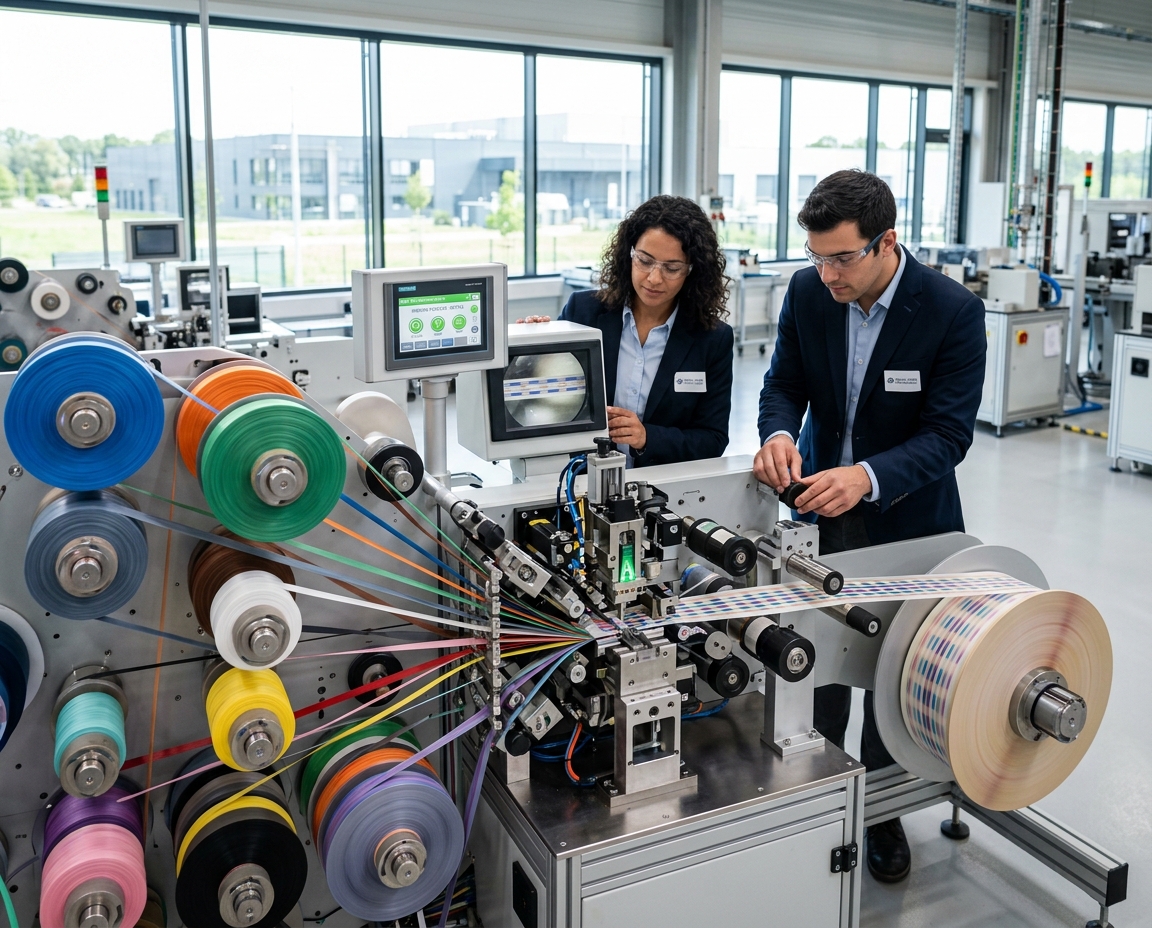 Intermittent Bonded Ribbon Production Line
How Rollable Ribbons Differ From Conventional Flat Ribbons
A conventional flat ribbon keeps its fibers in a single fixed plane. Between bonds, a rollable fiber ribbon can fold without losing the fiber alignment needed for mass-fusion splicing. Prysmian’s FlexRibbon uses compact bonding points to permit bending and folding.
How Flexible Ribbons Enable Compact, High-Density Cables
Inside a high-density fiber cable, a flexible ribbon can occupy less space. Cable designers can therefore accommodate more fibers in a compact structure without sacrificing an organized fiber layout.
Intermittent Bonded Ribbon Production Line: Process And Equipment
The intermittent bonded ribbon production process aligns optical fibers side by side along the ribbon’s length. A first material coats groups of two or more fibers to form subunits. Neighboring subunits are joined at separate points with a second material, leaving flexible sections between bonds.
Arrange Adjacent Optical Fibers Into Subunits
Fibers are placed beside one another according to the planned ribbon layout. Each selected group becomes a subunit when the first coating material encases and holds its fibers together.
Deposit Subunit Coating And Intermittent Bonding Material
Fiber ribbon coating forms the subunits. Bonding material is applied by a discrete coating applicator between neighboring subunits at spaced intervals, not continuously along their full length.
Create Diffusion Zones Through Wet-On-Wet Application
During wet-on-wet bonding, the subunit coating remains unset when bonding material is applied. The materials diffuse across their shared interface to form a diffusion zone.
Cure The Subunit Coating And Bonds Together
A single curing step sets both the subunit coating and the intermittent bonds. Although optical fiber ribbon equipment is used for these operations, the complete equipment list, line speed, and production capacity are not provided.
| Process Stage | Material Or Operation | Intended Purpose |
|---|---|---|
| Fiber arrangement | Place fibers side by side | Set the ribbon layout |
| Formation of subunits | Apply the first coating material around fiber groups | Hold two or more fibers as subunits |
| Intermittent bonding | Apply the second material between adjacent subunits | Join subunits at spaced points |
| Wet-on-wet bonding interface | Deposit bonds while the subunit coating remains uncured | Enable formation of a diffusion zone between the materials |
| Joint curing step | Cure coating and bonds in one step | Cure the assembled ribbon structure |
Key Production Line Stages And Process Controls
The fiber ribbon production stages proceed in a defined order. The sequence involves arranging fibers into subunits, applying a subunit coating, placing intermittent bonds between adjacent subunits, and curing the coating and bonds together. Optical fiber coating application and bond placement must correspond to the ribbon design.
Gaps of 5 to 100 micrometers between subunits are described in example designs. A range of 10 to 1,000 millimeters is specified for intermittent bond spacing in example designs. Some bond deposits take a diamond-like shape, tapering at the ends and widening in the center. The disclosed examples should not be treated as fixed settings that apply to every line.
Ribbon manufacturing process control depends on the chosen material selection, bond layout, and curing method. Because the source material provides no line speeds, curing temperatures, or inspection intervals, do not presume any values for them.
Ribbon Flexibility, Bond Design, And Materials
Material selection and bond layout determine how the ribbon behaves during cable making and splicing. Coatings shield each fiber while permitting the subunits to flex as intended.
Select Compatible Coating And Bonding Materials
Subunit coatings and ribbon bonding materials have distinct functions, so their formulas need not be identical. Resins that mix or remain at least partly soluble can produce a gradual interface. Lower coating viscosity may also promote intermixing.
A diffusion zone forms at this interface, with properties that vary gradually. The zone may differ in color, stiffness, surface friction, tear strength, or stretch. The disclosed thickness range is 2 to 50 micrometers, while 5 to 15 micrometers is given as a narrower range.
Manage Bond Placement, Spacing, And Geometry
Where subunits remain linked or move freely is governed by bond spacing. An intermittent bond layout creates unconnected spans separating the bond points. Intersecting convex and concave curves form the saddle shape used on some bond surfaces.
Balance Ribbon Flexibility With Fiber Organization
Unbonded spans allow the ribbon to shift from a flat layout into a rolled, curled, or folded shape. A flexible fiber ribbon design flexes during cable installation while keeping fibers organized for splicing.
Quality Checks For Consistent Ribbon Production
Instead of using assumed pass limits, dependable fiber ribbon quality checks focus on defined features. Design factors named in the patent include bond spacing, subunit gaps, diffusion-zone thickness, and bond shape. The patent does not, however, define inspection methods or acceptance limits.
Check Bond Continuity And Subunit Alignment
Check that intermittent bonds join adjacent subunits at planned locations and leave unbonded lengths between connections. Review subunit alignment and gaps because movement can affect ribbon shape and bond geometry.
Evaluate Ribbon Flexibility And Rollability
To evaluate ribbon rollability, watch whether it bends and gathers while keeping fibers in their original order. Throughout the ribbon design, evaluate bond spacing and flexibility. Treat these comparisons as design checks rather than universal production tolerances.
Verify Fiber Identification And Ribbon Configuration
Use fiber color coding to check the position of each fiber. A common 12-color sequence is blue, orange, green, brown, slate, white, red, black, yellow, violet, rose, and aqua. The color sequence may start again when a ribbon has more than 12 fibers.
Applications, Cable Integration, And Splicing Benefits
Intermittently bonded ribbons can roll inside a cable, enabling more fibers to fit into a compact design. Prysmian says FlexRibbon supports high-density ribbon cable designs, smaller diameters, and improved fiber duct utilization.
Enable High-Density Cable Designs And Better Duct Utilization
For indoor, outdoor, and indoor/outdoor applications, Prysmian provides FusionLink and MassLink with FlexRibbon. Dry water blocking is used in FusionLink, which comes with either 250 μm or 200 μm ribbon. EcoSpan aerial cable supports spans of up to 300 feet under NESC Heavy loading conditions. As a small-diameter outdoor option, FlexDrop can support up to two 12-fiber ribbons.
Support Mass-Fusion Splicing And Quicker Deployment
Multiple ribbon fibers, often 12 at a time, are joined in one operation through mass-fusion splicing. On compatible ribbon routes, this method can reduce splice time. For loose-tube cable connections, technicians separate the ribbon fibers and splice them one by one using a single-fiber splicer.
Consider Indoor, Outdoor, Access, And Broadband Uses
Applications for ribbon cable include point-to-point networks, indoor FTTH systems, MTP wiring-box links, and urban trunk routes. Selecting indoor and outdoor fiber cable for each route helps match cable construction with the needs of buildings, aerial runs, and underground installations.
Conclusion
Fiber layout, bond placement, curing, and inspection are combined in an intermittent bonded ribbon line guide. The process produces a flexible optical fiber ribbon that stays organized for handling while rolling or folding into compact cable designs.
In this process, bonds are placed before the subunit coating cures. Before they cure together, the materials develop a diffusion zone. Reliable fiber cable manufacturing is encouraged by careful control at every stage.
Mass-fusion ribbon splicing is also enabled by flexible ribbons, helping crews splice many fibers in one operation. FlexRibbon is described by Prysmian as suitable for multiple cable designs, including compact configurations with up to 6,912 fibers.
For manufacturers and network planners, the priority is to balance fiber alignment, bond strength, and rollability. Achieving that balance can simplify cable packaging while keeping ribbons ready for efficient installation and splicing.